Future Technologies That Will Shape The World
Introduction
Technology continues to evolve at a pace that influences every aspect of human life. Scientific research, digital transformation, automation, and computing advancements are creating new opportunities across industries and societies. Many technologies currently under development have the potential to change healthcare, transportation, communication, education, manufacturing, and environmental management.
The coming decades will likely be defined by technologies that improve efficiency, solve complex problems, and create new economic systems. Governments, businesses, and research organizations are investing billions of dollars in future technologies to remain competitive and prepare for changing global demands.
This article explores the future technologies expected to shape the world and examines their potential impact on industries and daily life.
Artificial General Intelligence
Artificial intelligence has already transformed many industries, but researchers are now working toward artificial general intelligence (AGI).
What Is Artificial General Intelligence?
Artificial General Intelligence refers to AI systems capable of performing intellectual tasks similar to human thinking. Unlike current AI models designed for specific functions, AGI could:
- Learn independently
- Solve complex problems
- Adapt to new situations
- Understand context
- Perform multiple tasks
Potential Applications
Artificial General Intelligence could transform:
- Healthcare
- Scientific research
- Education
- Manufacturing
- Government services
- Financial systems
Challenges
The development of AGI raises important concerns regarding:
- Ethics
- Security
- Regulation
- Employment
- Privacy
Researchers and policymakers continue discussing frameworks for responsible AGI development.
Quantum Computing
Quantum computing is expected to become one of the most influential technologies of the future.
How Quantum Computing Works
Traditional computers process information using binary digits. Quantum computers use quantum bits, or qubits, which can process multiple possibilities simultaneously.
Future Applications
Quantum computing may revolutionize:
- Drug discovery
- Climate modeling
- Financial forecasting
- Cybersecurity
- Material science
- Artificial intelligence
Industry Impact
Industries likely to benefit include:
- Healthcare
- Banking
- Manufacturing
- Energy
- Telecommunications
As quantum hardware improves, commercial applications will become more practical.
Brain-Computer Interfaces
Brain-computer interface technology aims to establish direct communication between the human brain and digital systems.
How Brain-Computer Interfaces Work
These systems capture brain signals and translate them into commands that computers can process.
Potential Uses
Future applications may include:
- Medical rehabilitation
- Communication assistance
- Human-computer interaction
- Education
- Entertainment
- Workplace productivity
Healthcare Benefits
Brain-computer interfaces could help patients with:
- Paralysis
- Neurological disorders
- Speech impairments
- Physical disabilities
Researchers continue improving the accuracy and safety of these technologies.
Advanced Robotics
Robotics technology is expected to become more sophisticated and widely adopted.
Humanoid Robots
Humanoid robots are being developed to perform tasks traditionally completed by humans.
Potential applications include:
- Healthcare support
- Customer service
- Manufacturing
- Education
- Elder care
Collaborative Robots
Collaborative robots, often called cobots, work alongside humans in workplaces.
Benefits include:
- Increased productivity
- Improved safety
- Reduced operational costs
Autonomous Robotics
Future autonomous robots may perform:
- Construction work
- Agricultural operations
- Emergency response
- Space exploration
- Industrial maintenance
Extended Reality Technologies
Extended reality includes virtual reality, augmented reality, and mixed reality technologies.
Future of Virtual Reality
Virtual reality may reshape:
- Education
- Entertainment
- Healthcare training
- Business meetings
- Tourism
Users could experience highly immersive digital environments.
Future of Augmented Reality
Augmented reality applications may become part of everyday life through:
- Smart glasses
- Navigation systems
- Workplace tools
- Educational platforms
- Retail experiences
Mixed Reality Environments
Mixed reality technology combines digital and physical spaces.
Potential uses include:
- Engineering
- Healthcare
- Manufacturing
- Defense
- Architecture
Autonomous Transportation
Transportation systems are expected to become increasingly automated.
Self-Driving Cars
Autonomous vehicles may provide:
- Improved road safety
- Reduced traffic congestion
- Lower transportation costs
- Greater accessibility
Autonomous Public Transit
Future public transportation systems may include:
- Self-driving buses
- Automated trains
- Autonomous taxis
- Smart transportation networks
Delivery Automation
Delivery technologies continue evolving through:
- Drones
- Autonomous trucks
- Delivery robots
These solutions may transform logistics and supply chain management.
Space Exploration Technologies
Space technology development continues to accelerate.
Commercial Space Travel
Private companies are investing heavily in:
- Space tourism
- Orbital transportation
- Lunar missions
- Space stations
Commercial space travel could become more accessible in the future.
Lunar Exploration
Several countries and private organizations plan to establish operations on the Moon.
Potential goals include:
- Scientific research
- Resource extraction
- Space manufacturing
- Deep-space missions
Mars Exploration
Human missions to Mars remain a long-term objective for many space agencies and private companies.
Research areas include:
- Transportation systems
- Habitat development
- Life support systems
- Resource utilization
Biotechnology and Genetic Engineering
Biotechnology continues advancing rapidly.
Gene Editing
Gene editing technologies may enable:
- Disease prevention
- Medical treatments
- Agricultural improvements
- Genetic research
Personalized Medicine
Healthcare systems may increasingly provide treatments based on individual genetic information.
Benefits include:
- Better treatment outcomes
- Improved diagnosis
- Reduced side effects
Synthetic Biology
Synthetic biology involves designing and creating biological systems for specific purposes.
Applications may include:
- Medical research
- Environmental restoration
- Food production
- Industrial manufacturing
Nanotechnology
Nanotechnology involves manipulating materials at the molecular level.
Medical Applications
Nanotechnology could support:
- Drug delivery
- Disease detection
- Cancer treatment
- Tissue repair
Manufacturing Applications
Industries may use nanotechnology for:
- Material production
- Electronics manufacturing
- Energy storage
- Industrial processes
Environmental Solutions
Nanotechnology may contribute to:
- Water purification
- Pollution reduction
- Waste management
- Renewable energy systems
Renewable Energy Technologies
Energy systems continue transitioning toward sustainable solutions.
Solar Technology
Future solar innovations may include:
- High-efficiency panels
- Solar windows
- Space-based solar systems
- Advanced storage technologies
Nuclear Fusion
Nuclear fusion research aims to produce energy through reactions similar to those occurring in stars.
Potential benefits include:
- Reduced emissions
- Long-term energy supply
- High energy output
Hydrogen Energy
Hydrogen technologies may support:
- Transportation
- Manufacturing
- Power generation
- Energy storage
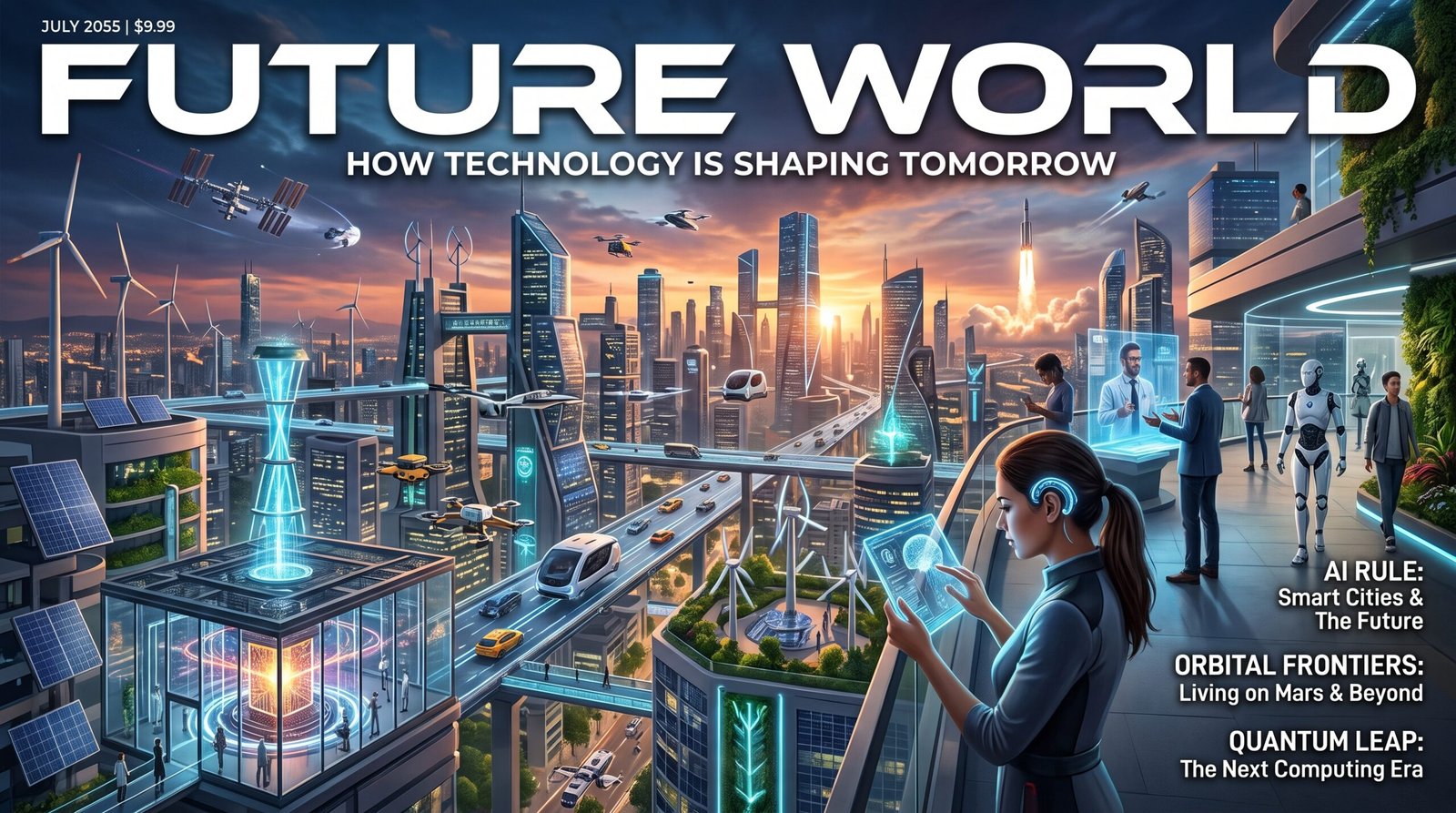
Smart Cities
Future cities will rely heavily on connected technologies.
Infrastructure Management
Smart cities may use technology for:
- Traffic control
- Waste management
- Public transportation
- Energy distribution
Public Services
Technology could improve:
- Healthcare access
- Emergency response
- Education
- Government services
Environmental Monitoring
Smart systems may monitor:
- Air quality
- Water resources
- Energy consumption
- Climate conditions
Internet of Things Evolution
The Internet of Things will continue expanding globally.
Smart Homes
Future smart homes may feature:
- Automated appliances
- Intelligent security systems
- Energy management tools
- Health monitoring devices
Industrial IoT
Industrial applications may include:
- Predictive maintenance
- Asset tracking
- Process automation
- Production optimization
Healthcare IoT
Healthcare devices could provide:
- Remote monitoring
- Health tracking
- Medical diagnostics
- Emergency alerts
Blockchain and Decentralized Systems
Blockchain technology continues evolving beyond digital currencies.
Decentralized Finance
Financial services may increasingly operate through decentralized systems.
Applications include:
- Digital payments
- Lending
- Asset management
- International transactions
Digital Identity
Blockchain-based identities may improve:
- Privacy
- Security
- Authentication
Supply Chain Transparency
Organizations may use blockchain to:
- Track products
- Verify transactions
- Improve accountability
Advanced Cybersecurity
As technology advances, cybersecurity becomes increasingly important.
Artificial Intelligence Security
AI-powered security systems may:
- Detect attacks
- Analyze threats
- Prevent breaches
- Automate responses
Quantum Encryption
Quantum communication technologies may create highly secure networks.
Zero Trust Systems
Future security models will likely require:
- Continuous authentication
- Identity verification
- Access monitoring
3D Printing and Manufacturing
Manufacturing technologies continue evolving.
Industrial Manufacturing
Advanced 3D printing may support:
- Automotive production
- Aerospace manufacturing
- Medical equipment
- Consumer products
Construction Industry
3D printing technology could enable:
- Faster construction
- Reduced costs
- Customized building designs
Medical Applications
Healthcare organizations may use 3D printing for:
- Prosthetics
- Medical devices
- Tissue engineering
- Surgical planning
Climate Technology
Climate technologies are becoming increasingly important.
Carbon Capture
Carbon capture systems may help reduce atmospheric carbon emissions.
Environmental Monitoring
Advanced technologies can track:
- Climate change
- Pollution levels
- Resource usage
- Ecosystem health
Sustainable Agriculture
Agricultural technology innovations may improve:
- Food production
- Water management
- Crop monitoring
- Resource efficiency
Challenges Facing Future Technologies
The development of future technologies creates several challenges.
These include:
- Data privacy concerns
- Security risks
- Ethical issues
- Regulatory requirements
- Workforce changes
- Economic inequality
Addressing these challenges requires cooperation between governments, businesses, researchers, and communities.
Conclusion
Future technologies will shape the way societies function, businesses operate, and individuals interact with the world. Artificial intelligence, quantum computing, biotechnology, robotics, space exploration, renewable energy, and digital systems will continue driving global transformation.
Understanding these emerging technologies helps governments, businesses, and individuals prepare for future opportunities and challenges. As innovation continues, societies that adapt effectively will be better positioned to benefit from technological advancement.
Frequently Asked Questions
What technology will have the biggest impact in the future?
Artificial intelligence, quantum computing, and biotechnology are expected to have significant global impacts.
Will robots replace human workers?
Robots will automate some tasks, but many industries will continue requiring human skills and oversight.
How important is quantum computing?
Quantum computing may transform scientific research, healthcare, finance, and cybersecurity.
What are smart cities?
Smart cities use digital technologies to improve infrastructure, public services, transportation, and resource management.
Why is renewable energy technology important?
Renewable energy technologies help reduce environmental impact while supporting long-term energy needs.